FREE sourcing support up to 3%

Eligibility applies to qualified business buyers and is confirmed after we review your product, quantity, destination, and sourcing requirements.

Process choice

Name which 3d laser engraving machine you mean

Buyers use 3d laser engraving machine for at least three different machines: a rotary or dynamic focus that follows a curved part, a grayscale process that varies depth in a flat substrate, and a subsurface mark inside a crystal or clear polymer. Quoting all three as one model produces a specification deviation before the price is even read. Pick the meaning, then hold every factory to it.
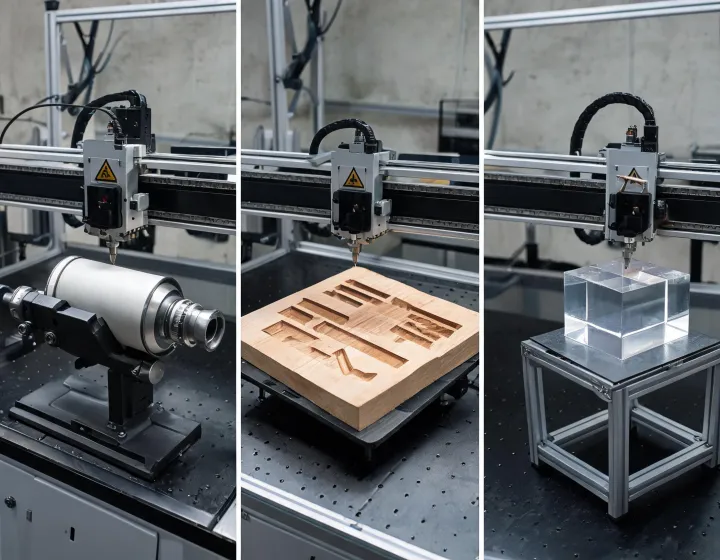
Three unbranded laser setups showing a rotary chuck, a flat depth sample, and a clear block
  1. Same meaning of 3D
  2. Same material and thickness
  3. Same quantity and destination
  4. Same included axis, lens, and software

Cost layers change when the 3D meaning changes

Layer Rotary or curved work Grayscale depth Subsurface clear media
Machine Axis and chuck called out, or excluded Power control and the depth method on the datasheet Source class the supplier says can mark inside the media
Attachments Tailstock, rollers, or a fixture drawing Lens and the software that maps gray values Fixture that holds the block square to the beam
Consumables Spare lens and any coating the metal curve needs Waste from test plaques in the real material Rejected blocks if the focus window is narrow
Freight Crate size with the rotary installed or shipped loose Usually the base machine crate Same crate question, plus shock notes for optics
Commissioning A curved sample run, not a flat coupon only Depth measured on a section, with the instrument named A clear sample the buyer supplies, with acceptance photos

No dollar figure belongs in this table. Delivered cost is the sum of the lines a supplier includes. A headline machine price that drops the rotary is a different configuration, even if the model family string matches. The US observation for this phrase is Volume 350 and KD 30 on 2026-05-16. It does not choose among the three meanings. Confirm rated power, working envelope, duty cycle, repeatability, input voltage, control interface, commissioning scope, bill of materials, and ingress protection on the model that matches the meaning you picked. A 10.6 µm CO2 label and a 1064 nm fiber label are source-class names to verify, not a depth measurement.

Selection questions before the inquiry goes out

Standard bed or an application-specific axis?

A standard flat bed keeps the document set smaller and can be enough for sheet goods. A curved or multi-level part may need a rotary, a lifting table, or dynamic focus. Ask the supplier to price the standard configuration and the added axis as separate lines. Choosing the added axis is an engineering call. It is not evidence that every 3D label includes that axis.

Headline power or a stated test basis?

Rated power is useful for a first screen when the datasheet states the condition. It does not describe edge quality, depth per pass, or contrast on your alloy or resin. Request the test coupon, the speed, the frequency or pulse note if the source uses one, and the measuring tool. Keep the headline as a screen and the test basis as the comparison field.

What does a lower purchase price leave out?

The low equipment line can be rational when attachments, filters, training, and spares are truly equal. If they are not listed, you are comparing capital cost with a partial lifecycle scope. Put consumables, commissioning, freight, and exclusions in the same columns on every offer. An optional budget does not close that gap by itself.

Lock the trade-off, then request the quotes

This page does not rank factories and it does not set a lead time. See metal options and wood scope if the job is flat stock instead. The procurement note is the longer checklist.

Request Factory Quotes